
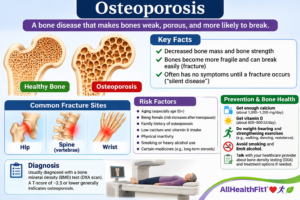
 A chronic skeletal disorder characterized by decreased bone mass, deterioration of bone microarchitecture, and reduced bone strength, resulting in an increased risk of fractures.
It occurs when bone resorption exceeds bone formation, causing bones to become weak, porous, and brittle.
Osteoporosis is often called a “silent disease” because it typically progresses without symptoms until a fracture occurs, most commonly in the hip, spine, or wrist.
Diagnostic criteria: In postmenopausal women and men aged 50 or older, osteoporosis is generally diagnosed by a bone mineral density (BMD) T-score of −2.5 or lower on a DXA scan. Certain fragility fractures may also establish the diagnosis.
Resource: National Institute of Arthritis and Musculoskeletal and Skin Diseases (NIAMS) – Osteoporosis