
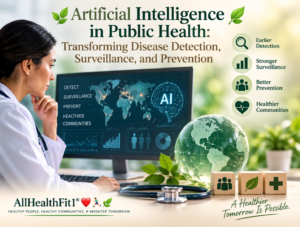
🌿 Artificial Intelligence in Public Health: Transforming Disease Detection, Surveillance, and Prevention 🌿
Artificial intelligence is rapidly changing how public health professionals analyze health information, identify emerging disease patterns, monitor populations, and respond to potential health threats. From infectious disease surveillance to predictive modeling and preventive health, AI may help public health systems recognize important signals earlier and use increasingly complex health data more effectively.
By Marjorie DiCarlo, M.D., Ph.D., M.P.H.
🌿 Introduction
A 2025 systematic review examining artificial intelligence in infectious disease early-warning systems identified 67 relevant studies, highlighting the rapidly expanding role of technologies such as machine learning, deep learning, and natural language processing in disease surveillance.
In 2026, the Centers for Disease Control and Prevention also introduced an artificial intelligence strategy for fiscal years 2026–2030 that specifically includes using AI to help accelerate disease detection and response.
These developments demonstrate how quickly artificial intelligence is becoming part of modern public health.
For generations, public health surveillance has depended on collecting information from hospitals, laboratories, physicians, health departments, and other sources. These systems remain essential, but collecting, organizing, and interpreting enormous quantities of information can take time.
Artificial intelligence introduces another layer of analytical capability.
AI systems can rapidly examine large datasets, recognize patterns, identify unusual changes, and potentially alert public health professionals to emerging concerns that warrant further investigation.
During my years working in healthcare, research, and public health, I have seen how important timely information can be when making decisions about prevention. Artificial intelligence does not eliminate the need for experienced healthcare and public health professionals. Instead, its greatest potential may be its ability to help professionals identify meaningful information more quickly and use that information to support better decisions.
🌿 How Artificial Intelligence Is Changing Public Health Surveillance
Public health surveillance involves the ongoing collection, analysis, interpretation, and use of health information to protect populations.
Traditional surveillance may incorporate information from:
- Hospitals and emergency departments
- Physician offices
- Public health departments
- Clinical laboratories
- Disease registries
- Pharmacy records
- Mortality records
- Community health programs
Modern digital systems can potentially add information from electronic health records, environmental monitoring, wastewater surveillance, wearable technologies, internet-based sources, and other datasets.
The challenge is no longer simply obtaining information.
Increasingly, the challenge is determining how to analyze enormous quantities of information efficiently enough to identify what matters.
How AI Analyzes Health Information
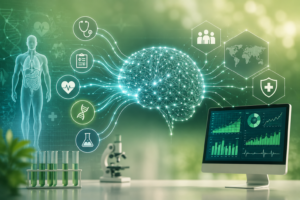 Artificial intelligence encompasses several technologies.
Machine learning allows computer systems to identify patterns within data and improve certain predictions based on the information provided.
Natural language processing can analyze written language, potentially allowing computers to identify relevant information within clinical notes, reports, news sources, and other text-based data.
Deep learning uses complex computational models capable of identifying patterns within very large datasets.
Predictive analytics combines data and statistical or computational techniques to estimate future outcomes or trends.
These technologies may allow public health professionals to process information much faster than would be practical through manual analysis alone.
However, AI-generated findings still require appropriate human interpretation.
An unusual pattern identified by an algorithm is not automatically evidence of an outbreak or public health emergency. It may instead provide a signal that professionals should investigate further.
🌿 Earlier Disease Detection and Outbreak Monitoring
One of the most promising applications of AI in public health is earlier detection of infectious disease outbreaks.
Traditional disease reporting can involve several steps.
A person becomes ill, seeks medical attention, receives testing, and obtains a diagnosis. Information may then be reported through healthcare and public health systems.
Each step takes time.
AI-enabled surveillance systems may help supplement these processes by analyzing multiple information sources simultaneously.
Researchers have explored AI applications using:
- Laboratory reports
- Electronic health records
- Epidemiological data
- Wastewater information
- Environmental and climate data
- Geographic patterns
- Internet-based information
- Population mobility data
When several unusual signals appear simultaneously, an AI system may identify a pattern deserving further investigation.
Recognizing Patterns Humans May Not Immediately See
This ability becomes particularly important when analyzing millions of pieces of information.
A small increase in illness in one community may not initially appear significant. But when combined with laboratory findings, geographic trends, environmental information, and similar cases elsewhere, the pattern may become more meaningful.
AI can help connect these signals.
Researchers have also investigated AI for influenza forecasting, healthcare-associated infection monitoring, antimicrobial resistance detection, and epidemic early-warning systems.
The goal is not to allow computers to independently declare an outbreak.
Rather, AI can serve as an additional analytical tool that helps epidemiologists and public health professionals recognize potential threats sooner.
Earlier recognition may provide additional time for investigation, testing, communication, and preventive intervention.
🌿 AI, Predictive Analytics, and Disease Prevention
 Public health has always emphasized prevention.
Artificial intelligence may strengthen prevention by helping identify populations, locations, or health trends associated with increased risk.
Predictive models can analyze historical and current information to estimate where certain health problems may be more likely to occur.
Potential applications extend beyond infectious disease.
AI and advanced analytics are being investigated in areas involving:
- Cardiovascular disease
- Diabetes
- Cancer
- Respiratory disease
- Environmental health
- Maternal health
- Population health
- Chronic disease management
The U.S. Food and Drug Administration also recognizes AI applications in medical technologies involving early disease detection, diagnosis, prognosis, risk assessment, medical imaging, and identification of patterns in disease progression.
🌿 Preventive Screening and Early Detection
Although AI may help public health systems identify population-level patterns, individuals still benefit from established preventive health practices.
Screening can identify certain health risks before symptoms become obvious, allowing individuals to discuss appropriate follow-up with healthcare professionals.
Life Line Screening provides preventive health screenings that may help individuals learn more about certain cardiovascular and other health risks.
Screening options may include assessments related to vascular and cardiovascular health, depending on the screening package selected.

👉 Schedule Your Preventive Screening Today!
Preventive screening should complement—not replace—routine medical care. Screening recommendations vary according to age, medical history, family history, symptoms, and individual risk factors.
🌿 Health Data, Laboratory Testing, and Personalized Prevention
Artificial intelligence is only as useful as the information being analyzed.
High-quality health data remain essential.
Laboratory testing provides objective information about many important biological markers and continues to play a major role in disease detection, monitoring, and prevention.
Common laboratory markers may provide information related to:
- Blood glucose
- Hemoglobin A1c
- Cholesterol
- Triglycerides
- Kidney function
- Liver function
- Thyroid function
- Nutritional status
When evaluated appropriately, these measurements can help healthcare professionals identify risk factors, monitor existing conditions, and determine whether additional evaluation may be necessary.
🌿 Understanding Personal Health Data
As digital health technologies continue to evolve, individuals are gaining greater access to their own health information.
Ulta Lab Tests offers access to a variety of laboratory tests that may help individuals monitor important health markers and discuss their results with a qualified healthcare professional.

👉 Explore Health Testing Through Ulta Lab Tests
Laboratory results should always be interpreted within the appropriate clinical context. A single abnormal result does not necessarily establish a diagnosis, and normal laboratory results do not rule out every health condition.
The combination of appropriate testing, professional interpretation, preventive screening, and healthy lifestyle practices remains important even as AI becomes more widely incorporated into healthcare and public health.
🌿 The Challenges and Ethical Responsibilities of AI in Public Health
Artificial intelligence offers tremendous potential, but it also introduces important challenges.
AI should not automatically be assumed to be accurate simply because it can analyze large quantities of information.
Data Quality
AI models learn from data.
Incomplete, inaccurate, outdated, or unrepresentative data can produce unreliable conclusions.
The quality of the underlying information therefore matters enormously.
Bias and Health Equity
If certain populations are poorly represented within the data used to develop an AI system, its predictions may perform differently across groups.
Public health organizations must therefore consider fairness and health equity when developing and implementing AI technologies.
Privacy
Public health surveillance may involve sensitive health information.
Protecting privacy and maintaining appropriate data security are essential as increasingly sophisticated technologies analyze large health datasets.
Transparency
Some complex AI systems can produce predictions without making it immediately clear how the system reached its conclusion.
This is sometimes described as the “black box” problem.
Healthcare and public health decisions can have significant consequences. Professionals therefore need appropriate information about how AI systems work, their limitations, and the reliability of their predictions.
Human Oversight Remains Essential
Perhaps the most important principle is that artificial intelligence should support—not replace—professional judgment.
AI can identify patterns.
It can process data.
It can generate predictions.
But experienced epidemiologists, physicians, nurses, laboratory professionals, researchers, data scientists, and public health leaders remain essential for interpreting those findings and deciding what actions are appropriate.
The strongest future public health systems may therefore be those that combine technological capability with human expertise.
🌿 AllHealthFit1® Pro Tip ❤️🏃♀️
Artificial intelligence may help public health professionals identify health threats earlier, but technology is only one part of prevention.
Personal prevention still matters.
Routine healthcare visits, recommended screenings, appropriate laboratory testing, vaccination, healthy nutrition, physical activity, and attention to important health changes remain fundamental components of preventive wellness.
AI may help professionals understand health information faster, but informed individuals and qualified healthcare professionals remain central to turning information into meaningful health decisions.
Think of AI as another tool in the public health toolbox—not a replacement for human expertise.
🌿 Frequently Asked Questions
1. How is artificial intelligence being used in public health?
AI is being explored and used for disease surveillance, outbreak detection, predictive modeling, analysis of large health datasets, disease forecasting, and other public health applications.
2. Can AI predict disease outbreaks?
AI can analyze multiple data sources and identify patterns that may indicate an increased risk of an outbreak. These findings still require investigation and interpretation by public health professionals.
3. Will artificial intelligence replace epidemiologists and healthcare professionals?
AI is better viewed as a tool that can support professionals. Human expertise remains essential for interpreting findings, evaluating context, communicating risk, and making public health decisions.
4. What are the risks of using AI in public health?
Important concerns include inaccurate or incomplete data, algorithmic bias, privacy, cybersecurity, lack of transparency, and unequal access to technology.
5. How can individuals benefit from advances in health technology?
Digital health technologies may improve access to health information, monitoring, screening, and early detection. However, technology should complement established preventive healthcare and professional medical guidance.
📚 Continue Reading
👉 🌿 Antimicrobial Resistance: A Growing Global Public Health Threat
Learn why antimicrobial resistance is making some infections increasingly difficult to treat and how infection prevention and responsible antibiotic use may help protect these lifesaving medications.
👉 🌿 Diabetes and Kidney Disease: What Recent Research Reveals About Protecting Kidney Function
Explore practical approaches to cardiovascular and metabolic wellness through prevention, screening, nutrition, physical activity, and informed health decisions.
🌿 Stay Connected With Our “Healthy You Insider” Newsletter 🌿
Receive weekly health & wellness insights covering public health, preventive health, nutrition, fitness, healthy aging, and emerging health topics to support your journey toward a healthier you.
📚 References
- Centers for Disease Control and Prevention — AI Strategy (FY 2026–2030)
- National Library of Medicine — Artificial Intelligence in Early Warning Systems for Infectious Disease Surveillance: A Systematic Review
- National Library of Medicine — Harnessing Artificial Intelligence for Enhanced Public Health Surveillance
- U.S. Food & Drug Administration — Artificial Intelligence Program: Research on AI/ML-Based Medical Devices
🌿 Affiliate Disclosure:
This article may contain affiliate links from select partners, including Life Line Screening and Ulta Lab Tests. If you choose to make a purchase through these links, I may earn a small commission at no additional cost to you. Your support helps sustain the development of science-based health information through AllHealthFit1™.
⚠️ Medical Disclaimer:
Content on AllHealthFit1™ is provided for educational and informational purposes only and is not intended as medical advice. Always consult a qualified healthcare professional regarding medical concerns, symptoms, screening, laboratory testing, diagnosis, or treatment decisions.
🩺 In Health & Wellness,
Marjorie DiCarlo, M.D., Ph.D., M.P.H.
AllHealthFit1® ❤️🏃♀️🍃